
China is attracting Western studios more and more, and the figures give a good sense of what is economically at stake. With more than 700 million players and a market that can generate up to 50 billion dollars in annual revenue, the country represents an opportunity that is hard to ignore. And yet, between intentions and reality, there is still quite a gulf. According to a study conducted by the site Rokky among 300 American and British developers, 80% are considering launching a game in China by 2028. The problem is that a good many of them admit they don’t really know how that market works.
A market that doesn’t work the way it does in the West
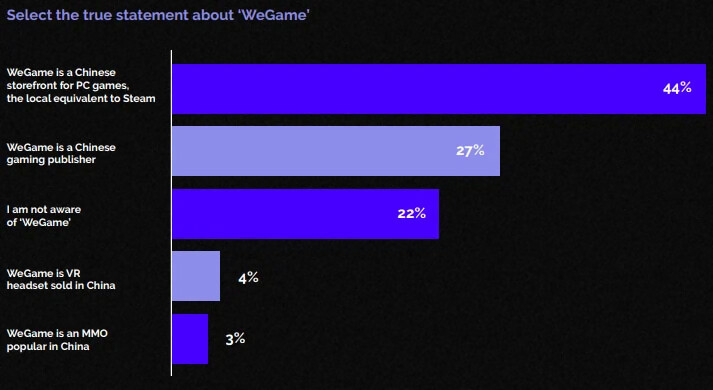
China has become the third most frequently targeted region by Western studios for their launches. Nearly half of those surveyed, 49.5%, have in fact already released a game there over the past five years. But once you get into the detail, the gaps quickly appear. No fewer than 43% of developers cite the difficulty of finding local partners as a major obstacle. 38% fear piracy or intellectual property theft, while 32% admit they don’t know how to communicate effectively with the Chinese public. Even the way licences work remains unclear to some, since 11% say they don’t understand the necessary steps. Distribution is a problem too. Nearly half of respondents believe it is impossible to release a game in China without going through a local company. And only 44% correctly identify WeGame, the Chinese platform comparable to Steam. More surprising still, 27% think it is a Chinese publisher.

Western methods aren’t enough
The real problem therefore lies less in the interest shown in the Chinese market than in the way it is approached. The tools and platforms normally used to promote a game in the West are not necessarily available in China. Google Ads, for example, is blocked there, while regulatory constraints can require specific versions of certain games. PUBG Mobile, Minecraft, VALORANT and ARC Raiders have all had to adapt their presence to the Chinese market. Even player habits are sometimes poorly understood. Some developers believe, for instance, that Chinese players mainly use VPNs to reach the international version of Steam. In reality, “game booster” services, which among other things allow connections to foreign servers, play an important role.
Rokky’s conclusion is therefore fairly simple: Western studios have perfectly grasped China’s commercial potential, but not yet the specifics needed to succeed there. Applying the same distribution and marketing methods as in Europe or the United States isn’t enough. And the phenomenon now works both ways. Chinese studios are also increasingly looking to win over Western audiences, with productions such as Genshin Impact, Black Myth Wukong, Wuchang Fallen Feathers, Blood Message and Tides of Annihilation, which are designed from the outset to reach an international public. The next step might therefore be less a conquest of China by Western studios than a genuine coming together of two ecosystems that are only just learning to work with one another.