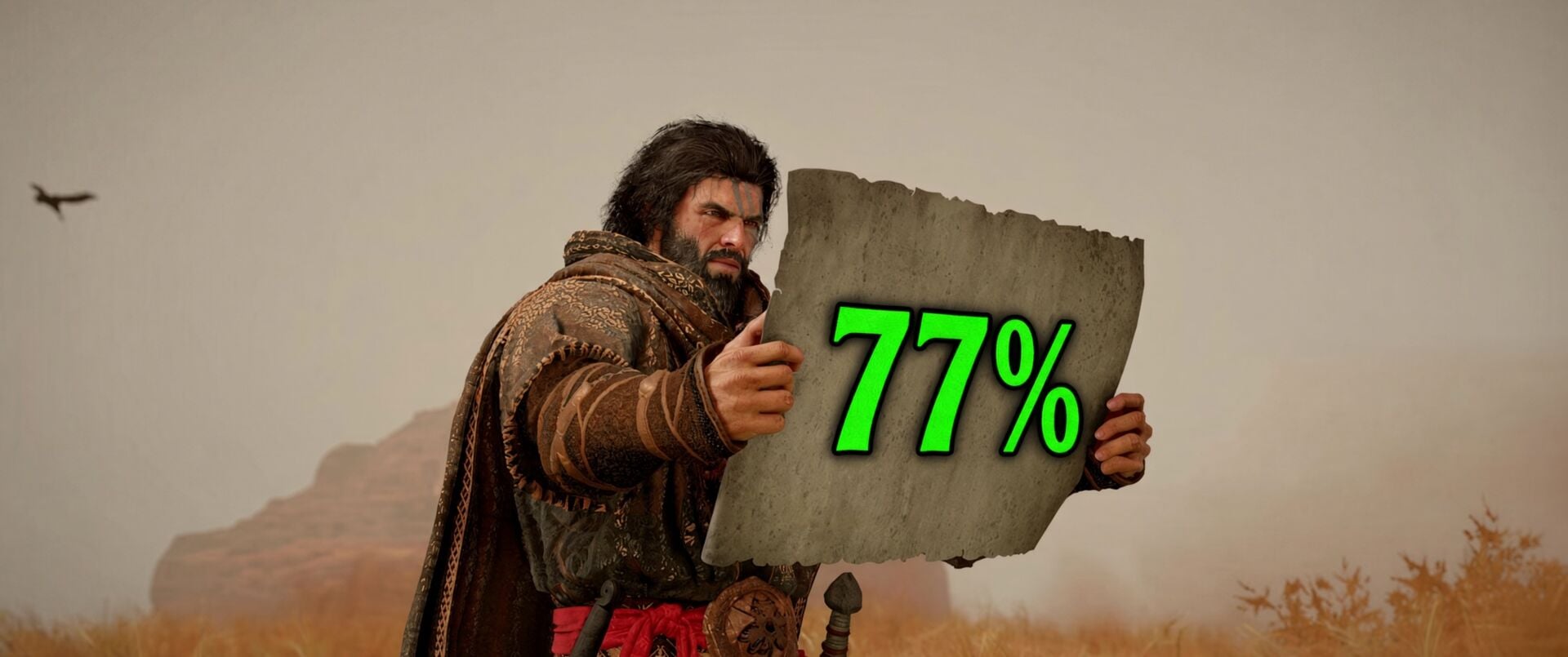

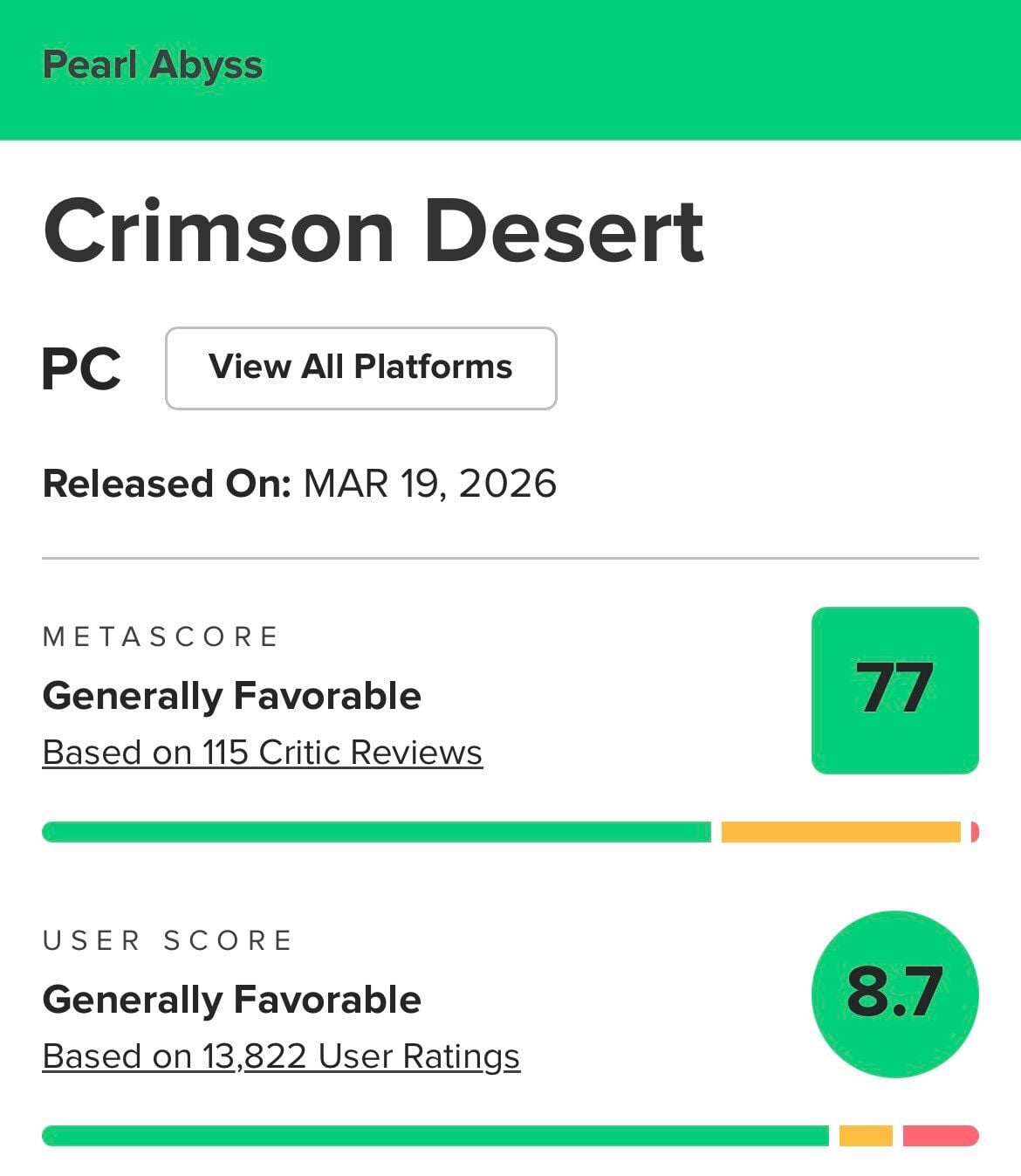
77% on Metacritic from the press, against a User Score of 8.7/10 from players: Crimson Desert shows a significant gap between professional critics and the public, who seem to have bought into Pearl Abyss' pitch far more readily. How do you explain such a difference when the game has clearly found its audience? Lybee Park, managing director of Pearl Abyss in Europe, has her own theory, and reckons journalists simply didn't have enough time to discover every facet of this open-world adventure. In fact, in an interview with The Game Business, Lybee Park pointed out that the press had to make do with a different build from the one that shipped at launch, and above all with limited review time. « I think both sides have valid arguments, especially the critics », she explained, before stressing the richness of an open world whose qualities don't necessarily reveal themselves if you only follow the main quest. In her view, much of what makes Crimson Desert interesting lies in the details tucked away in its world, and mainly in organic discovery, where there are no markers at all. The possibilities offered by exploration and all those small details that are easily missed by anyone who has to deliver a verdict to a set deadline.
The Discord of discord
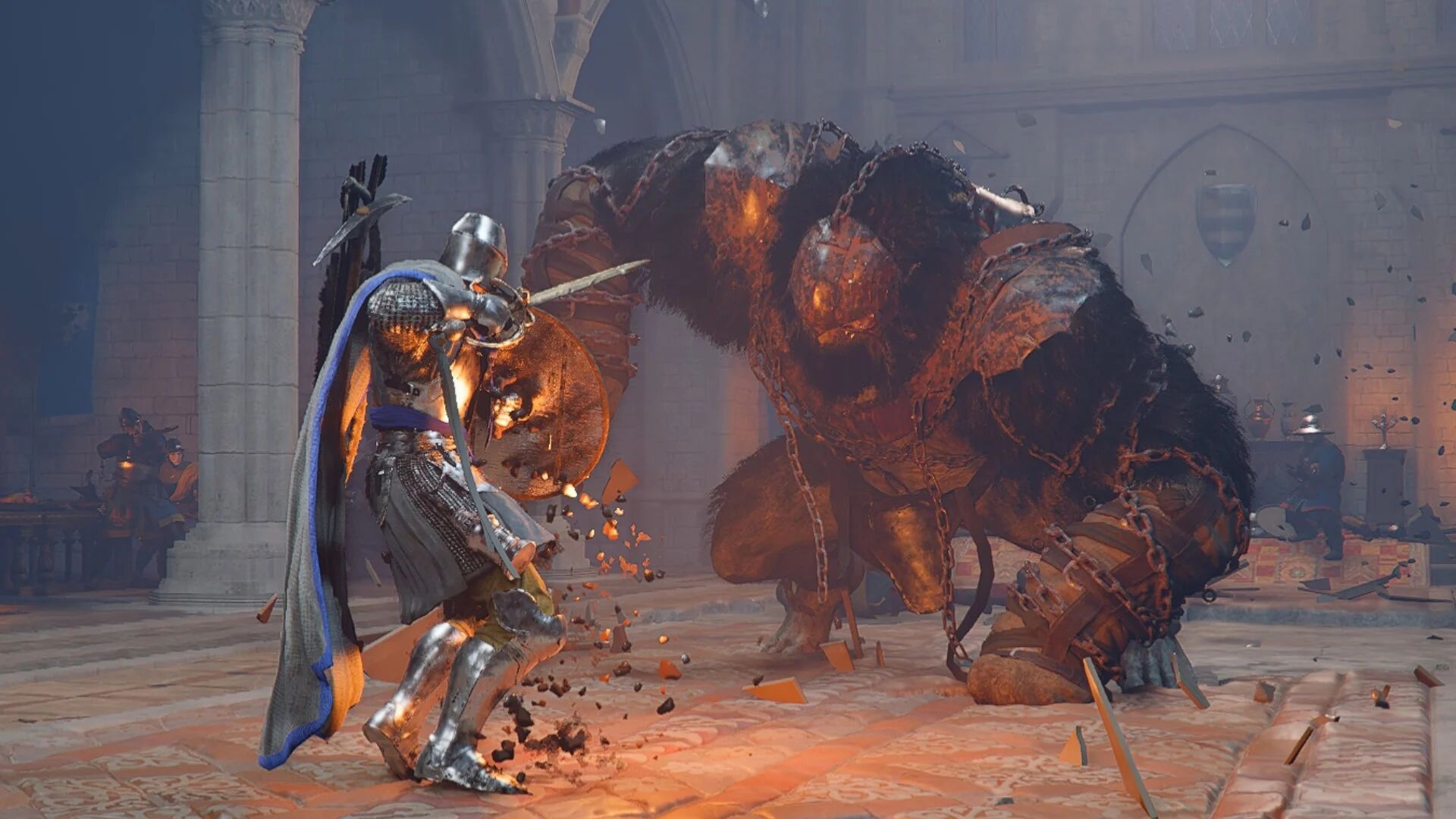
On that point, the CEO of Pearl Abyss Europe isn't wrong, and we're going to spill a little. During the review period, the Korean studio set up a Discord bringing together every reviewer from around the world. As far as I can remember, it was the first time such a thing had been done, opening up discussion between journalists, which to my mind is a huge mistake, since one person's opinion can colour another's. There was also a real gulf between reviewers in how they approached the game, with sometimes heated discussions about its difficulty and its puzzles. Plenty got stuck on certain sections, grumbled about puzzles deemed too obtuse or about mechanics that needed more time to sink in. Crimson Desert never holds the player's hand and can be particularly frustrating when you don't understand what it wants from you. Some journalists even admitted on the Discord that they had handed in their score without getting past Chapter 5, after the gorilla fight (unpatched at the time). This obviously shouldn't be generalised to the whole press, but these accounts illustrate the problem nicely: some of the reviews may have been built on a fairly limited experience of the game.
Pearl Abyss has its share of the blame too
That said, Pearl Abyss can't simply point the finger at the constraints the press works under. When you develop a game this massive, with an open world that encourages you to stray off the beaten track, puzzles that are sometimes devious and systems that take time to master, you also have to accept that a few days of review time (we had 15 days, weekends included, and 3 of those were ruined by a game reboot that wiped saves and progress) isn't necessarily enough. And when I talk about limited time, I know exactly what I'm talking about, because to finish Crimson Desert's main quest and still lose myself in side content, I pushed sessions to the point of exhaustion, stringing together days running from 9 in the morning to 3 in the morning, with no real break (I'd warned the wife and kids in advance that Dad wasn't coming out of the games room). Except that once you put the pad down, the job is far from over. You still have to step back from what you've just played, organise your thoughts and write a review precise enough to do justice to a game of this scale.
For those producing video content as well, the workload is even heavier, since you have to capture gameplay footage, record commentary, pick out the relevant sections, then edit the video before you can publish it. All that time spent on production obviously can't be spent in-game. In the end, between the writing, the capture and the editing, that's easily 3 to 4 days of review time vanishing off the calendar. Three or four days you could have spent carrying on exploring the world, pushing further into the quests or digging into mechanics you hadn't yet got to grips with. For a game that specifically asks you to take your time, that constraint is anything but trivial.
When you develop a game this massive, with an open world that encourages you to stray off the beaten track, puzzles that are sometimes devious and systems that take time to master, you also have to accept that a few days of review time (we had 15 days, weekends included, and 3 of those were ruined by a game reboot that wiped saves and progress) isn't necessarily enough.
By handing out a build that differed from the launch version and setting a schedule that didn't always allow for a deep dive, Pearl Abyss helped create the very conditions for this gap between press scores and player feedback. The studio could hardly have been unaware that an open world this dense, with puzzles that can be demanding and a progression that leaves plenty of room for experimentation, would need more time to get to grips with than a more linear game. If you want critics to explore what makes a title singular, you have to give them enough room to do it, bearing in mind the constraints of the job. And that goes for every game, every publisher, every studio, by the way.
So who's right?
That doesn't mean every negative review is unjustified, nor that the issues with pacing, difficulty or legibility that some players ran into should be waved away. A review remains a personal opinion, and a game can be thoroughly ambitious while still suffering from flaws worth pointing out. But there's a difference between criticism formed after genuine exploration and criticism based on an experience cut short — while acknowledging that the Korean studio also bears some responsibility for how that experience plays out.
Since Crimson Desert launched back in March, Pearl Abyss has in fact kept working on the game with several updates covering difficulty, extra content and graphical performance. These tweaks may well have improved the experience, but they also muddy any comparison between the original review conditions and what players get today. The game the journalists assessed wasn't quite the one the public discovered at launch, and the updates have carried on the balancing work month after month.
Now, let's be clear: a 77 on Metacritic is hardly a disaster, even if Pearl Abyss was evidently hoping for a warmer critical reception. Set against a User Score of 8.7/10, though, the gap is worth examining. Lybee Park is right to point out that Crimson Desert isn't just its main quest and that its best surprises sometimes turn up when you take the time to wander off the beaten path. But that richness comes at a cost: it demands time, patience and review conditions to match. Between reviewers stuck on puzzles, those who delivered their verdict before Chapter 5, the hours spent writing and producing video, and the save-file problems, the circumstances were far from ideal. In short, everyone has their share of responsibility, and an episode like this could well become a textbook case. In the meantime, as of today, Crimson Desert remains my biggest gaming discovery of 2026. But the year isn't over yet...