Now that Crimson Desert has been out for several months, how do you look back on its launch? Are you happy with the results and with how players have received the game?
It's genuinely exciting. For the whole team and for every single one of us, it's incredible. Everyone has been on high alert for months, because we're so excited to read all the comments, to look at all the content the fans are creating and to see this staggering amount of positive feedback. It's completely mad. Of course, we're extremely happy and grateful for this success, but honestly, it goes far beyond what we initially expected. So yes, we've sacrificed quite a few hours of sleep poring over player feedback and delivering the updates they needed.
You recently announced that you'd passed 6 million sales back in June. Where do things stand today?
We hit that figure in exactly 86 days. In the first week we'd passed 2 million, then 6 million after 83 days. As for the current numbers, we've officially announced six million copies.
When we first met in 2024, you were already aware that Crimson Desert's controls could be demanding. You eventually decided to change them after launch. What made you go back on that design choice?
It was first and foremost a design decision. Our developers make the game they genuinely want to play themselves, you see? And it's also something they can be proud of. At a certain point, we said to ourselves: "This is our way of doing things, our language, our approach to the game." But we also received an enormous amount of feedback, both externally and internally. In particular, we ramped up our internal testing and review sessions. In the end, we felt it might make sense to adjust certain elements, while trying to preserve the original approach we had with those controls.
So how did the team take that decision to change the controls? [...] Some of our members were indeed very sad, even genuinely disappointed, at having to give up a philosophy they were proud of. But we also felt that we wanted to reach a much wider audience and community.
Sure, but those controls were part of the game's identity. Was that a difficult decision to make for the developers who had built that gameplay philosophy in the first place? For my review, I spent more than 120 hours with the game and I got used to the controls. I was even proud of having managed to master them. When you changed them, I have to say I was a little frustrated...
Yes, you understood what we were trying to do. You felt the same thing we did. So how did the team take that decision to change the controls? I can speak on behalf of the whole team. Some of our members were indeed very sad, even genuinely disappointed, at having to give up a philosophy they were proud of. But we also felt that we wanted to reach a much wider audience and community. Because difficult controls simply aren't for everyone. We didn't want that to become too big an obstacle for people who were genuinely interested in our game.
Let me offer a counter-example with Red Dead Redemption 2, which also had very particular controls and which Rockstar never really tried to bend to suit players. Why not stick to your guns with Crimson Desert?
That's true, you're right, but Red Dead Redemption 2 is the second entry in an already established franchise. They already had their community, their audience and well-established expectations. Players knew what to expect in terms of difficulty, and how far Rockstar Games would push its own philosophy. For us, this is our very first single-player game. And then there's something that comes from Pearl Abyss's DNA. We're the developers of Black Desert Online, which is an MMORPG and a live-service game. That really is an important part of Pearl Abyss's DNA. Originally, then, we were very much geared towards live service. And that experience is precisely what allows us to adapt. Today, we can apply that ability to adapt to a single-player game.
Since release, you've rolled out a steady stream of updates and adjustments. How far are you willing to let Crimson Desert evolve based on community feedback?
This is my personal opinion, but I like to think of our community and our fans as a kind of organic content, as part of the game's content. They naturally improve and evolve the way they interact with our game, our philosophy and our approach. Obviously, we don't take every piece of feedback at face value. But it's hugely inspiring. Our developers always try to translate that feedback into their own language and fold it into the game when it makes sense. And the fact that we're very responsive and able to move quickly also explains why there have been so many updates since launch. One a week.
It sometimes feels like your team never stops, given how the updates and improvements keep coming. Where does that energy and that drive to keep improving the game after launch come from?
It's the excitement, the passion. We're so proud of what's happening. And all this hugely positive feedback pushes us to go even further. Nobody is forcing us to do any of this. It's voluntary work. We simply can't rein in our enthusiasm and that energy. And on the technology side, our developers were here on Monday, at Gamescom Dev, to present the BlackSpace Engine. That's actually one of the reasons we're able to develop our own engine in-house.
It's true that the Asian mindset is very different from the way things are approached in the West. It's something I experience on my end too, with my outlet. People often say I overdo it, when it isn't necessarily relentlessness, just the desire to do things properly...
We try to explain that to Western audiences too, because the Asian mentality isn't necessarily the same. When you're passionate about something, you want to work even harder to prove you're capable of making something really solid and really ambitious. That's exactly it. Speaker 2: It generally comes from the heart.
Voice acting in several languages, including French, was one of the big recent surprises for the community. Was it planned from the outset, or was it a decision taken after launch?
Of course! It was planned from the outset. France is obviously a very important market for us, and we know how big a fanbase we have in the country. We also know how much they love the game, but reality caught up with us. This is our very first game of this type. And on top of that, we had to manage a simultaneous launch across several platforms, as well as all the localisation. All those very concrete constraints caught up with us. Even though we really wanted to offer French voice acting at official launch, reality didn't allow it. But we did our best to release it within a realistic timeframe, while also bringing in a number of improvements. We didn't just want to deliver the original voices and leave it at that. We wanted to offer genuine additional content to our fans, with a bigger and better-quality experience.
Why choose to announce nothing before release, rather than telling players the French dub would arrive a few months later?
No, we wanted it to be a surprise. And we didn't want to create too much expectation either. We didn't want to announce something that might ultimately disappoint players, because you never know what can happen and it could also have been delayed.
The decision to bring in a number of well-known French actors also went down very well. At a time when the use of AI-generated voices is increasingly debated in the industry, why was it important for you to work with real actors?
Why did we choose real actors? Quite simply because our characters, especially the playable ones, don't talk a great deal in the game. Every line of dialogue therefore has to carry a lot of meaning and convey a precise intention. It's very condensed. So for our original English and Korean dubs, we developed our own guidelines. We had defined the qualities a performance needed to have, the approach to take, and so on. And we applied those principles. But we also have our European office, with genuine French members on the team. For the French market, we wanted to preserve the characteristics and intentions of our original designers, while finding an approach that really works for our French fans. So we did a huge amount of reviewing and discussing in order to pick the right actors for the game. That's why we never even considered using AI-generated voices.
Now that Crimson Desert is out and you've had time to analyse player feedback, what are your priorities for the future of Crimson Desert? Multiplayer, perhaps?
Unfortunately, we can't comment on the multiplayer question. Our main priority right now is the DLC planned for this year. And unfortunately this isn't the right place to announce it, but that single-player expansion is coming. That's all we can say. We can't give any further details, but that's our priority going forward (the DLC has since been announced)
You've also been working on DokeV for a long time. Now that Crimson Desert is in players' hands, will DokeV's development be able to speed up?
Our team is working flat out on DokeV. And that impressive amount of positive feedback around Crimson Desert is encouraging our team as well. It shows us we're capable of creating a game that players love, an interesting game, one that can reach an international audience. So yes, we're working on it, but unfortunately we can't give any more details.
Crimson Desert is a brand-new IP that's now enjoying genuine international success. Have you already started thinking about what might come next, perhaps even a Crimson Desert 2?
Sadly, we can't really talk about that at this stage. What I can say is that we don't just want to take away the positives from this success and from our experience with the Crimson Desert launch. We're also compiling everything we could have done better, the things we need to avoid in future, and so on. We're building our own “playbook” for DokeV, so that no detail of this incredibly valuable Crimson Desert experience gets lost. But we were also able to apply what we learned from Black Desert to Crimson Desert. We now have multiplayer experience with Black Desert, single-player experience with Crimson Desert, and we've also learned how to speak to a far broader audience. So I think we can do even better.
With more than 6 million copies sold, an ambitious open world that's arguably the best since Red Dead Redemption 2, and a very positive international reception, you've set the bar extremely high. Does that success create a form of pressure for your next projects?
Yes, we're aware of it. We know it very well. But it motivates us. Everyone now expects the very best from our next products, and we'll do everything we can to deliver.
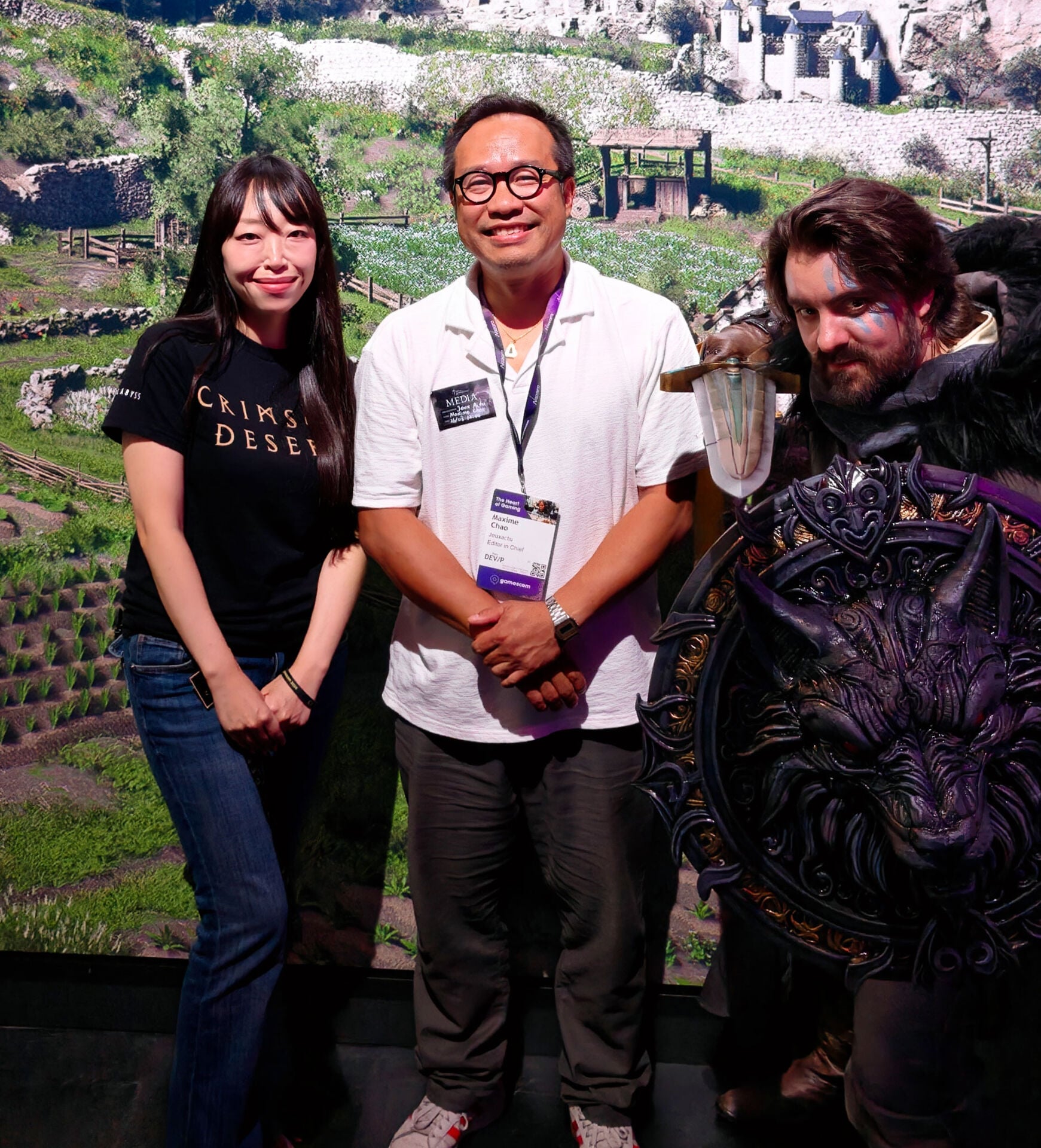
Interview conducted at gamescom by Maxime Chao on 26 August 2026.