With a Metascore of 87% and a User Score of 8.7/10, Gears of War E-Day is one of the best-received entries in the franchise — there's no doubt about that. Unfortunately, its sales on Xbox are said to be nowhere near expectations for such a major exclusive. According to estimates from the firm "Alinea Analytics", the game has shifted around 230,000 copies since its early access launch on 1 October, of which only 62,000 on Xbox Series, against 168,000 on PC. Extremely low numbers, and surprising ones for such an iconic licence — though it's worth remembering that The Coalition's title was available day one on Game Pass. More than enough to seriously reignite the debate about the effect Game Pass has on Xbox game sales.
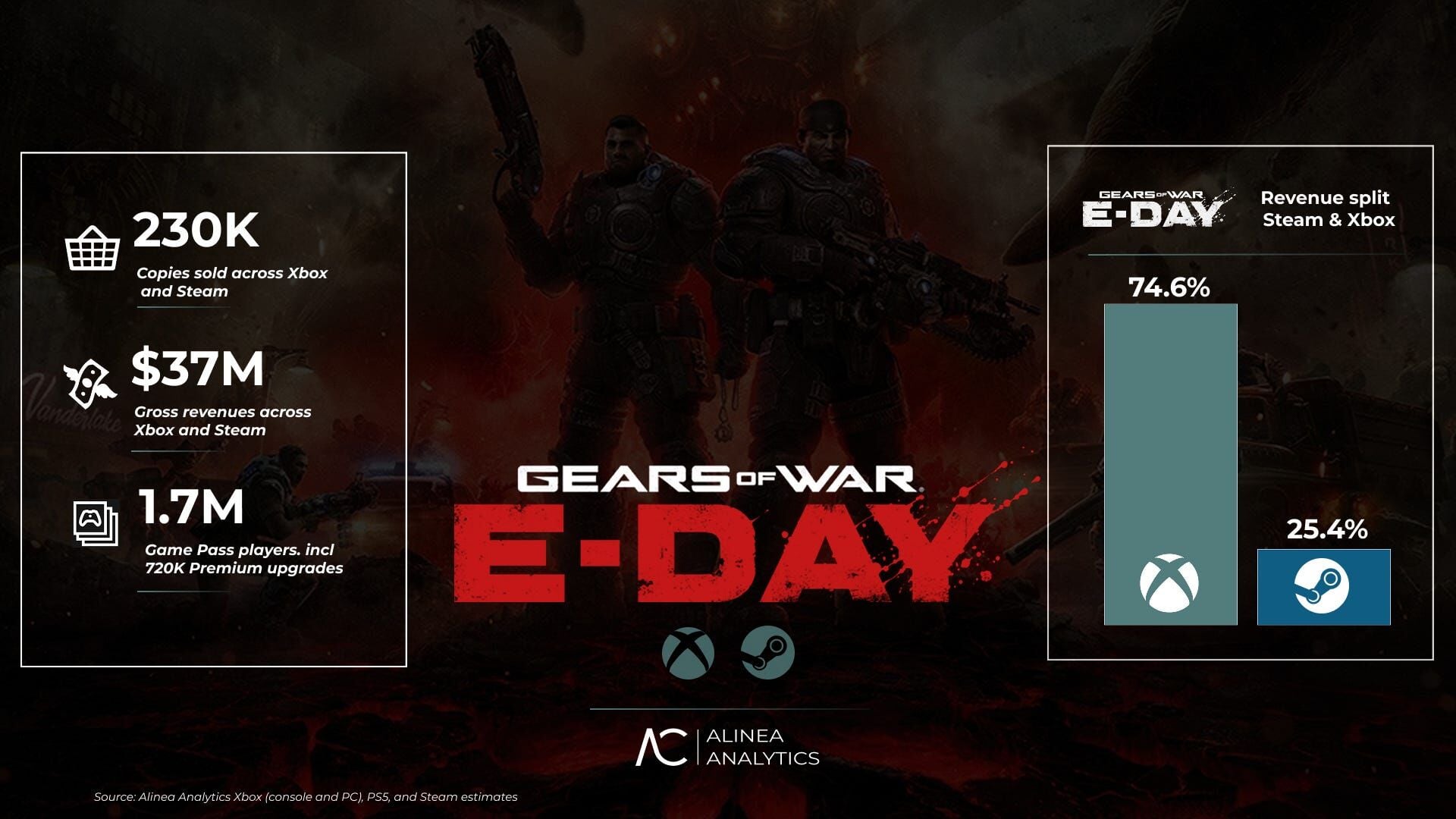
As we know, Microsoft no longer systematically shares sales figures for its games, which forces analysts to rely on outside estimates to gauge their commercial performance. The data put forward by Rhys Elliott, head of market analysis at Alinea Analytics, should therefore be taken with a pinch of salt, as it hasn't been officially confirmed by the publisher. That said, if Alinea Analytics is to be believed, the firm reckons the game has generated roughly $37 million in total revenue ($26 million on Xbox, $11 million on PC). The reason largely comes down to the business model Microsoft chose, since Game Pass subscribers can try the game without buying it separately — but a portion of them were willing to pay extra to get in early. According to the firm, 722,000 players bought the Premium upgrade, priced at $30/€30, to play ahead of the official release. That offer alone is thought to have brought in around $21.7 million. Add those purchases to standard sales and nearly 950,000 players have spent money to access Gears of War E-Day, which does put those 230,000 copies into perspective.
Is Game Pass killing Xbox game sales?
By putting Gears of War E-Day on Game Pass from day one, Xbox offers a particularly tempting way in for players who don't fancy paying full whack for a new game. Even so, Rhys Elliott considers the results disappointing for such a major licence, at a time when Microsoft is trying to improve the profitability of its gaming division. In his view, some of the subscribers who paid $30/€30 for early access might have bought the game at $70/€70 had it not been available on Game Pass from the off. Obviously, there's no way of knowing how many would really have taken the plunge, and it would be a stretch to treat every Premium upgrade as a lost sale.
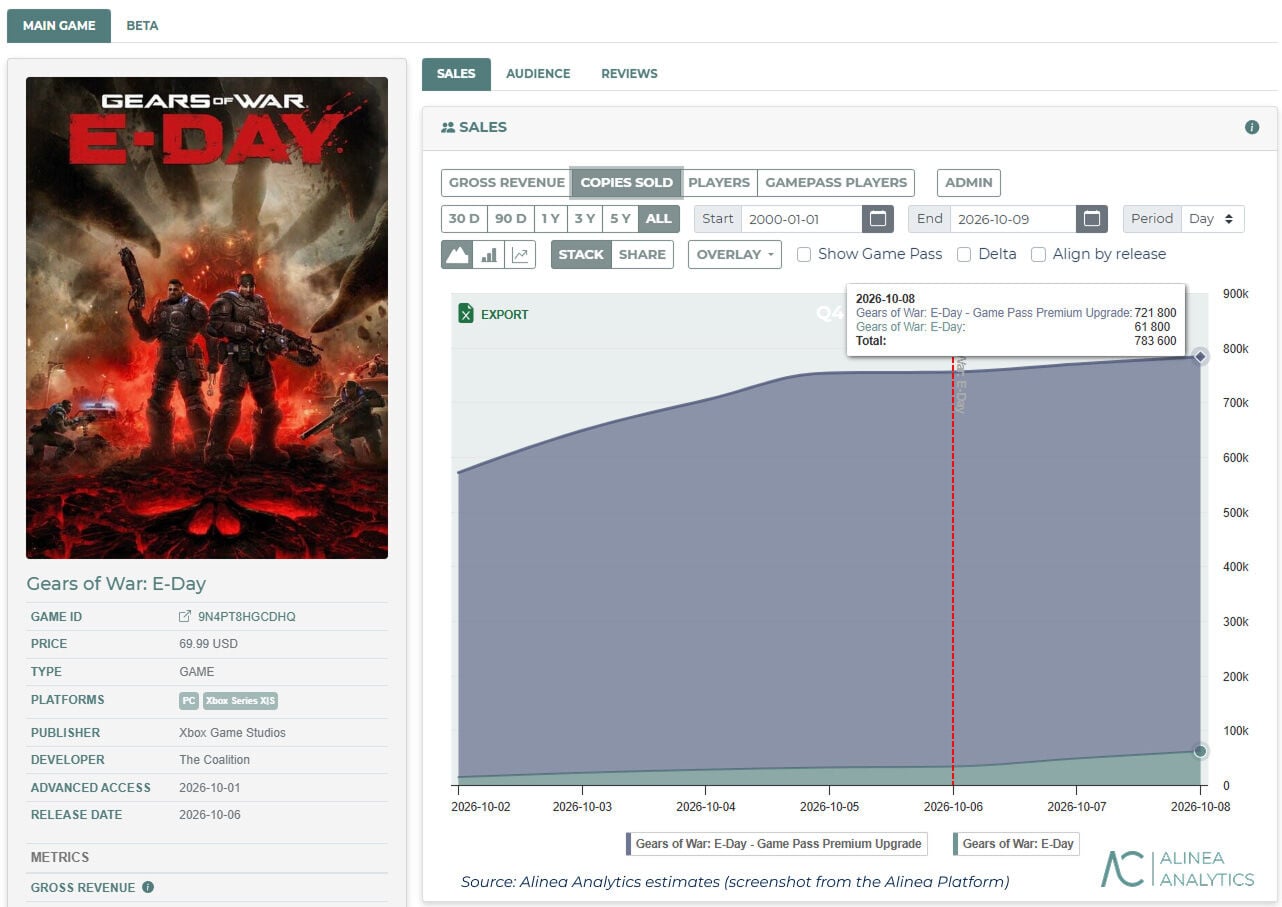
The equation isn't that simple, then, and the problem is subtler than a straight stand-off between subscriptions and purchases, because we know Game Pass lets millions of players discover titles they might never have bought. On the other hand, when a hotly anticipated game is available at no extra cost on day one, it becomes much harder to convince subscribers to spend $70/€70 to own a copy. This phenomenon isn't entirely new at Microsoft, either. Documents made public in 2023 as part of the Activision Blizzard acquisition had already raised the potentially negative effect of Game Pass on traditional sales of games included in the service. More recently, Xbox decided to stop putting new Call of Duty entries on the subscription at launch, with upcoming instalments set to arrive around a year later. A strategy shift that shows the question of how profitable day-one releases really are is still very much alive within Xbox.
In the end, Fenix is struggling to rise from the ashes
The paradox is all the more striking given that Gears of War E-Day has had a very warm critical reception. The game has been praised for its back-to-basics approach and the quality of its campaign, which makes its traditional sales on Xbox all the harder to read. But the number of copies sold is no longer enough to measure a game's performance when a large chunk of its audience comes through a subscription. Alinea Analytics' data also shows that Xbox players don't behave quite like those on Steam. Around 54% of Xbox players are said to have spent five hours or less with the game, against 32% on Steam. Conversely, 33% of Steam players have apparently clocked more than 15 hours, compared with 19% on Xbox. The firm puts that gap down to how easy it is for subscribers to fire up a game from the catalogue to give it a go, then move on to something else if it doesn't grab them.
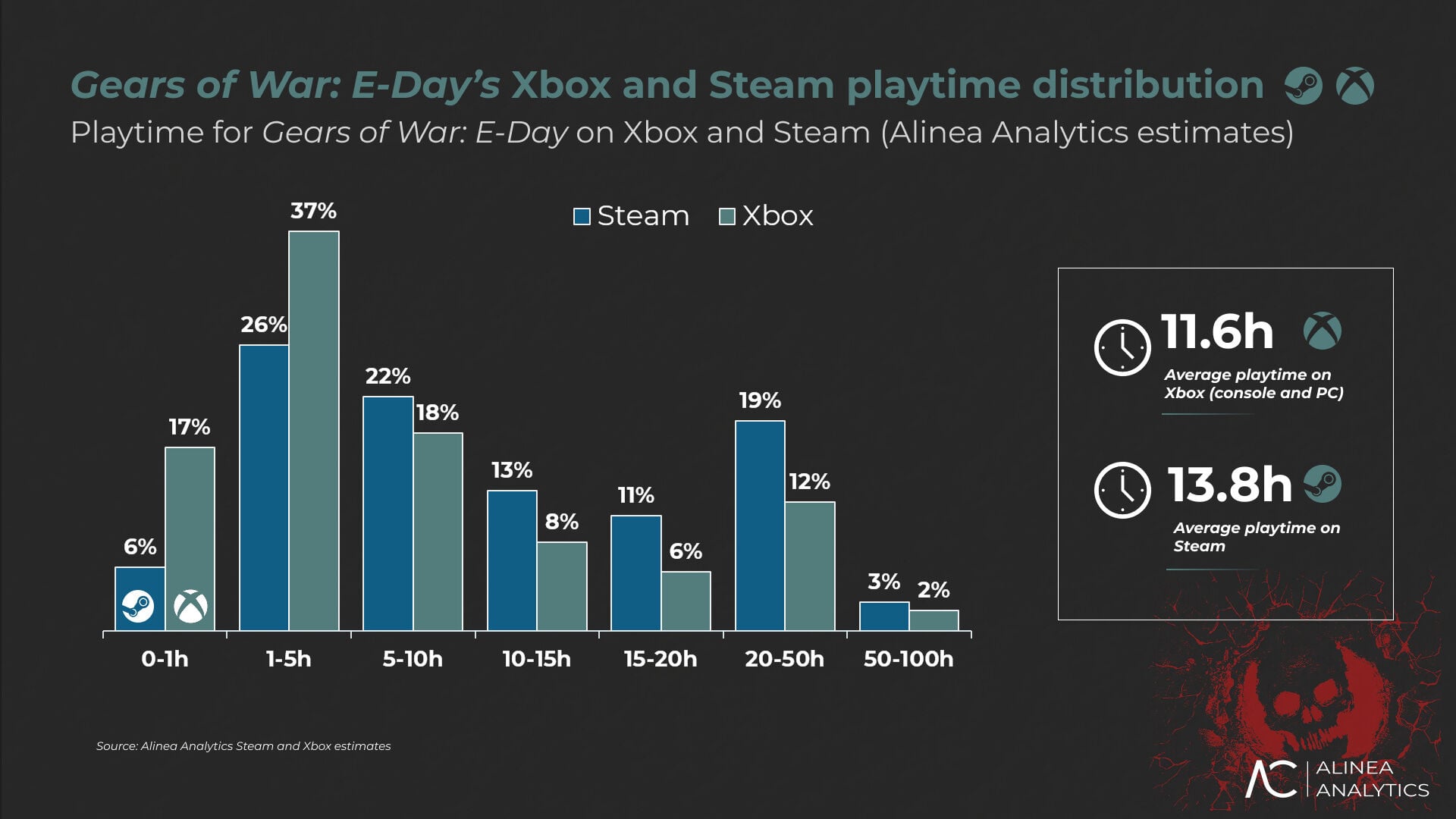
Microsoft therefore finds itself facing a tricky dilemma: while Game Pass gives its productions visibility and serves as a major selling point for attracting and retaining subscribers, it can also make it harder to shift games at full price, even when those games are genuinely good. At this stage, Alinea Analytics' estimates don't allow us to gauge precisely how much revenue may have been left on the table, nor to work out the game's impact on new subscriptions. They do, however, highlight a contradiction at the heart of Microsoft's model: if Xbox wants to grow its revenues, making its biggest productions available day one on Game Pass could limit the direct sales the company also needs. A solution will have to be found for this business model, which isn't profitable and has been barrelling along at full speed for a long time now.