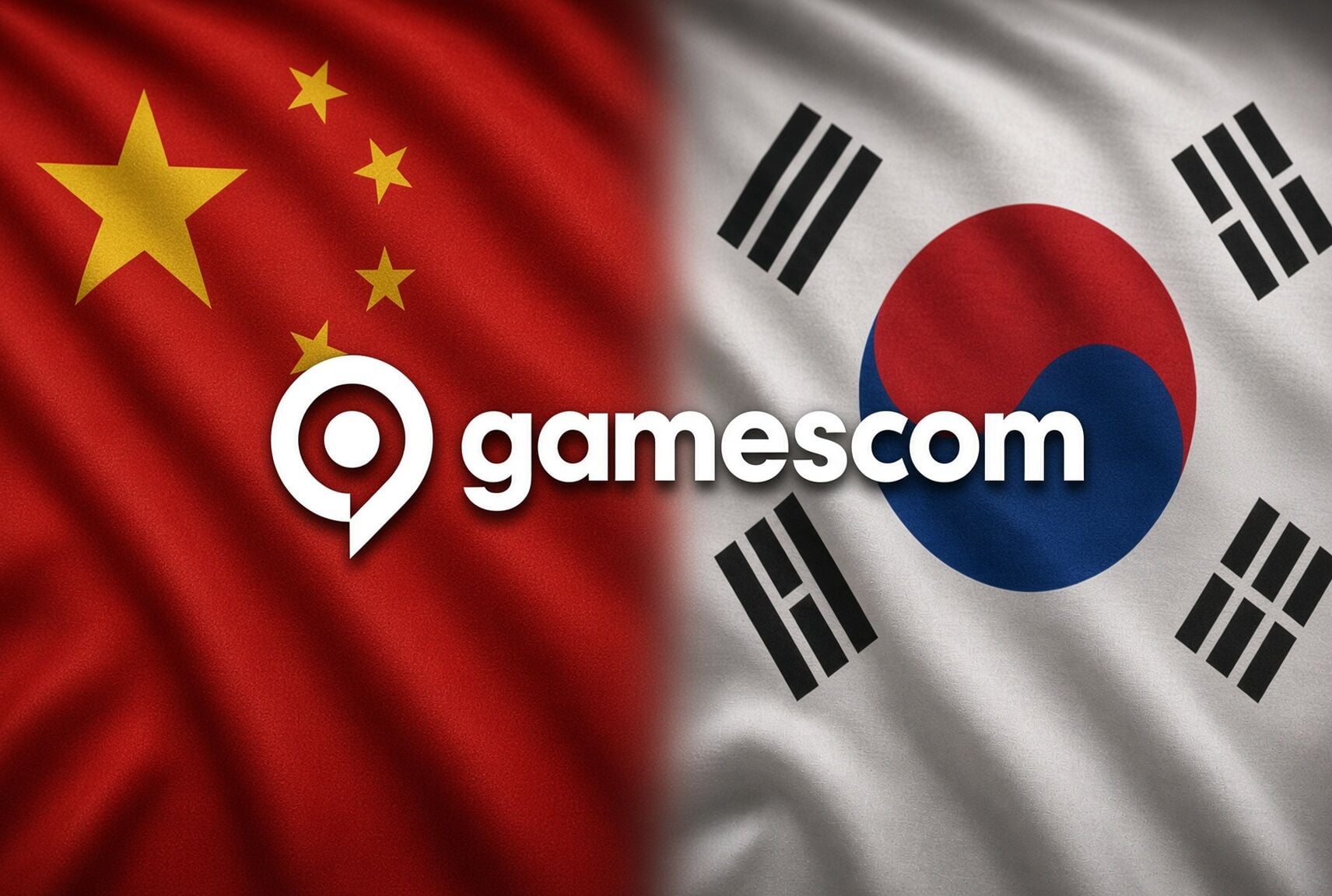

It is a scoop to nobody by now: Asia has become a fundamental player in video games, and it shows more and more on the international stage. As Geoff Keighley pointed out during his gamescom 2026 address at Opening Night Live: “Gaming is changing, and changing considerably”. It was all the more striking this year in Cologne, where walking the show’s halls made clear that the balance of power is shifting before our eyes. Not only because there are far more Chinese and Korean studios than before, but because their ambitions are no longer the same. Let us explain.

Asian Fever
Only a few years ago, part of the Chinese industry came to gamescom to show its games to Western audiences, find partners, sign distribution deals and try to gain a foothold in a market still largely dominated by the Americans, the Europeans and the Japanese. But in 2026, the talk has changed. China is no longer simply trying to conquer international markets; it now wants to take a direct part in creating the global video game. And that shift in vocabulary sums up fairly well what is happening. Consider this: this year, no fewer than 60 Chinese companies were present at gamescom — unprecedented, and quite simply a record. But the figure on its own doesn’t say much. What is far more interesting is the nature of the games these companies come to show and, above all, the way they present them.
Take ANANTA, for example. NetEase no longer simply presents its game as a title meant for export to the West. Above all, it is looking to build a gigantic open world blending action, exploration, driving, side activities and city life, with clearly international ambitions. And even if comparisons with GTA are inevitable, the studio explains precisely that it doesn’t want to be reduced to the “Chinese GTA” label, since it wants to build its own identity and its own model.Tides of Annihilation, from Chinese studio Eclipse Glow Games, is even more telling. On paper, you could hardly get more Western: London, Arthurian legend, knights, a city ravaged by a supernatural invasion… And yet the studio claims a Chinese reading of that Western material. In other words, it is no longer simply about importing foreign references to win over an international audience: Chinese developers are starting to make them their own and reinterpret them with their own sensibility.
Tai chi technique
For a long time, the globalisation of video games mostly ran one way. Asian studios looked at Western and Japanese productions, observed their codes, their mechanics, their staging, then tried to adapt them to their own market. Today the movement is far more circular. Where Winds Meet fully owns its Chinese roots while offering a production designed, technically and artistically, to reach players the world over. Phantom Blade Zero does the same with the wuxia aesthetic, that Chinese tradition of tales of whirling knights and martial arts. And Arknights Endfield shows just how capable Chinese studios now are of building extremely ambitious science-fiction universes around licences and concepts that don’t need to be Westernised to work. Even HoYoverse, which has already shown with Genshin Impact and Zenless Zone Zero that a Chinese studio can build worldwide phenomena, seems to want to go further still.
With Nodusfall, the group is even taking the risk of leaving its comfort zone. The game moves away from the anime aesthetic that made its previous productions a success and offers a co-op adventure oriented more towards fighting gigantic creatures. Its universe draws in particular on the Classic of Mountains and Seas, blending Chinese mythologies with influences from other cultures. It is probably one of the most important developments of recent years.
A Western developer interviewed by Xinhua in fact explained that Chinese culture now amounts to a genuine gateway into these games: seeing Chinese architecture, a creature from a local legend or an unfamiliar cultural element is precisely what can spark a player’s curiosity. We have therefore gone from “how do we get Westerners to understand our game?” to a far more interesting question: “how do we make them want to discover our universe?” And this shift goes well beyond the big studios. Zoopunk, Sea of Remnants, Escape from Duckov, The Defiant, Genigods Nezha — the diversity of Chinese productions on show in Cologne shows there is no longer really a single “Chinese game”. There are now RPGs, action games, open worlds, indie games, multiplayer experiences, science fiction, fantasy and far more experimental projects. That is also what helps explain why the comparison with Japan is becoming less and less relevant.
Because yes, for decades, when a Western player talked about great Asian games, they naturally thought of Japan: Nintendo, Sony, Capcom, Konami, Sega, Square Enix, FromSoftware… Japan of course remains extremely powerful and Gamescom 2026 was a reminder of that with Onimusha Way of the Sword, Mega Man Dual Override, Stranger Than Heaven, Crazy Taxi World Tour and Metal Gear Solid Master Collection Vol. 2. Not the most original games of the moment, true, but the Japanese are still there.
Land of the Morning Calm
But alongside that historic power, a new force has settled in: South Korea. Pearl Abyss’s Crimson Desert is probably the most spectacular example of this rise. But it is no longer alone: PUBG DED.NET, No Law, Project ZETA and TARAE The Unbound also testify to Korean studios’ determination to step outside the traditional online-game framework and offer productions capable of rivalling big international releases. And here too, the phenomenon isn’t just a question of budget, it is a question of confidence. Something has changed in the way these studios now look at the Western market, since they no longer seem to be seeking acceptance. They seem to consider that they now have their place at the table of the big Western studios. And that confidence isn’t entirely unfounded, since the successes of Genshin Impact, Black Myth Wukong, Wuthering Waves, Zenless Zone Zero, Where Winds Meet and Crimson Desert have shown that a game developed in China or Korea can become a worldwide phenomenon without necessarily going through Hollywood, Japan or the United States to acquire legitimacy.
Most interesting of all is that some of these games are starting to influence Western developers in turn. The borders have become far more porous. Chinese teams are opening offices in Los Angeles, Toronto and Europe. They recruit international talent, they work with local teams, and above all they take Western players’ habits into account far earlier in development. In other words, internationalisation no longer comes at the end of the process, it starts at the design stage. And that may be the real “creating global” the Chinese industry talks about. It is no longer simply a matter of taking a game finished in China, translating it into English, adding a few marketing campaigns and selling it in Europe and the United States. It is about building an international team, an international game, an international strategy and, above all, a licence that can live independently of its country of origin, right from the start.
AI to go faster, with no shame in using it
Technology also plays a part in this shift of paradigm in the games industry. Chinese companies are investing massively in artificial intelligence and developing their own tools, some of them meant to be used beyond their own productions. In China, AI now seems to be approached with far fewer hang-ups in the video game industry. It is used to speed up certain stages of development, produce tools, automate certain tasks, help with localisation or otherwise support teams in their work. And above all, Chinese studios seem far less obsessed with the idea of having to hide their use of it for fear of being immediately accused of “cheating” or of replacing artists.
It isn’t necessarily that Chinese developers think AI can do everything; it is rather that they seem to have accepted a fairly simple idea: if a technology saves time, cuts certain costs or lets a small team do more, you may as well use it. And that may be where Asia could gain a head start. In the West, the debate around AI has often become extremely anxiety-inducing. Before even asking what the tool actually makes possible, we ask what we are supposed to think of it morally, what image it will project, how artists, players, unions or social media will react. Some companies even prefer to say as little as possible about their use of AI, precisely because they know it can turn into a controversy.
That caution is understandable. There are real questions around training data, copyright, paying creators and the place of the human in creative work. But there is also an opposite risk: through fear of using AI badly, the Western industry could end up using it less than those who have agreed to experiment.
As Thanos says, it is inevitable
For a long time, China wanted to prove it was capable of making games as beautiful, as big and as sophisticated as those produced elsewhere. Today, it is starting to want to prove something far more ambitious: that it can produce the games the whole world will want to play. And that nuance matters — it changes everything. Because from the moment a Chinese studio can tell a Chinese story to the whole world, reinterpret a British legend with a Chinese sensibility, build an open world that isn’t simply trying to be “the Chinese GTA”, or blend several mythologies without wondering which one is supposed to be the dominant reference, the balance of power shifts. And that is probably what Gamescom 2026 will have shown most clearly. And frankly, for us players, that is rather good news.