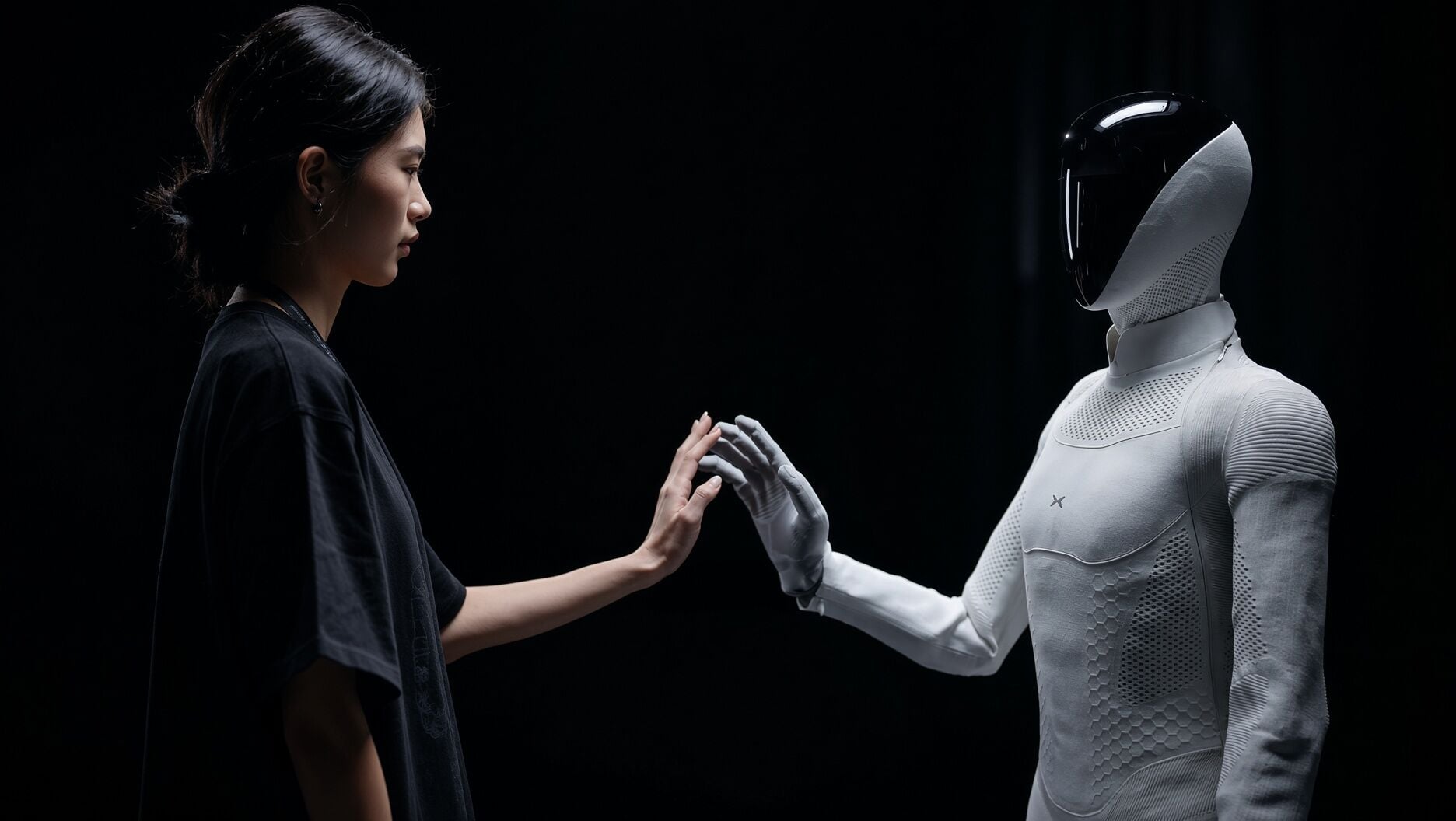

Doing the washing-up, tidying the living room, running the hoover round or sorting the laundry: all everyday chores we could soon be handing over to humanoid robots. If that prospect still felt like science fiction a few years ago, Chinese carmaker Xpeng believes we are now very close to it becoming reality. In an interview with CNBC on Thursday 26 November 2026, the company's co-president Brian Gu explained that technological progress has come far enough that the first deployments of humanoid robots in people's homes could be on the cards 1 to 2 years after they have successfully settled into professional environments. The comments came a day after the firm unveiled the new generation of its Iron humanoid robot at its AI Day in Guangzhou, China.

A humanoid robot in every home
The Chinese manufacturer, which first made its name with electric cars, it's worth recalling, intends to start mass production of its Iron robot as soon as January 2027. Initially, these humanoids will be trained to work as sales assistants in the brand's car dealerships. Sales are due to begin in the second quarter of 2027, with the first deliveries expected in the second half of the year. That said, while humanoid robot demos have been multiplying online in recent months, the real challenge will be getting all their capabilities to work at the same time. As Brian Gu explains, making a robot talk, making it run or teaching it to handle objects are feats the industry has already mastered to varying degrees. Asking it to carry out a task while moving around and answering questions, without losing its balance or getting distracted, is a far trickier technological problem.
To pull it off, Xpeng plans to draw on the expertise it has built up in autonomous driving. The manufacturer has just unveiled its new architecture, dubbed "Turing Physical AI", which allows both its vehicles and its robots to make decisions in real time using artificial intelligence. The company also has its own chips, which limits its dependence on American technology and on the restrictions imposed on exports of Nvidia's most advanced components to China.

A far more profitable market than cars
The key takeaway from Brian Gu's comments is that he believes it will be easier to turn a profit in robotics than in the car business. Xpeng's robotics division raised 900 million dollars over the summer of 2026, at a valuation of 6.3 billion dollars. The manufacturer is even hoping to reach profitability in the sector as early as 2027, at a time when its share price has lost more than 55% of its value since the start of the year. There remains, however, a gulf between a robot that can greet customers in a car dealership and a humanoid autonomous enough to move around a house. The presence of children, elderly people or pets imposes far stricter safety requirements. These machines will also need sufficient battery life, the ability to react to unforeseen situations and the capacity to carry out their tasks with consistent reliability.
Either way, a new technological battle is taking shape between China and the United States. While Elon Musk harbours grand ambitions for Tesla's Optimus robot, Chinese firms such as Xpeng and Unitree are moving at a far more impressive pace, and it becomes much clearer why Jensen Huang was a thorn in the side of certain American patriots. Having profoundly upended the global electric car market, China could well pull off the same trick with humanoid robots. One big unknown remains, of course: the price at which these machines will be offered to consumers. Because between owning a robot that can do the housework and actually being able to afford one, there is still quite a gap.